 Custom AI Works
Grow Faster with a Seattle AI Partner Who Knows Your Market
Seattle is one of the densest technology markets in the world — and most of its economy isn't Big Tech. It's First Hill clinics, maritime and port trades, agencies, and neighborhood businesses losing hours to intake, documents, and missed calls. We're based here, and we build the automation that gives those hours back.
Based in Seattle · UW Medicine, Swedish & VMFH corridor · maritime & port trades
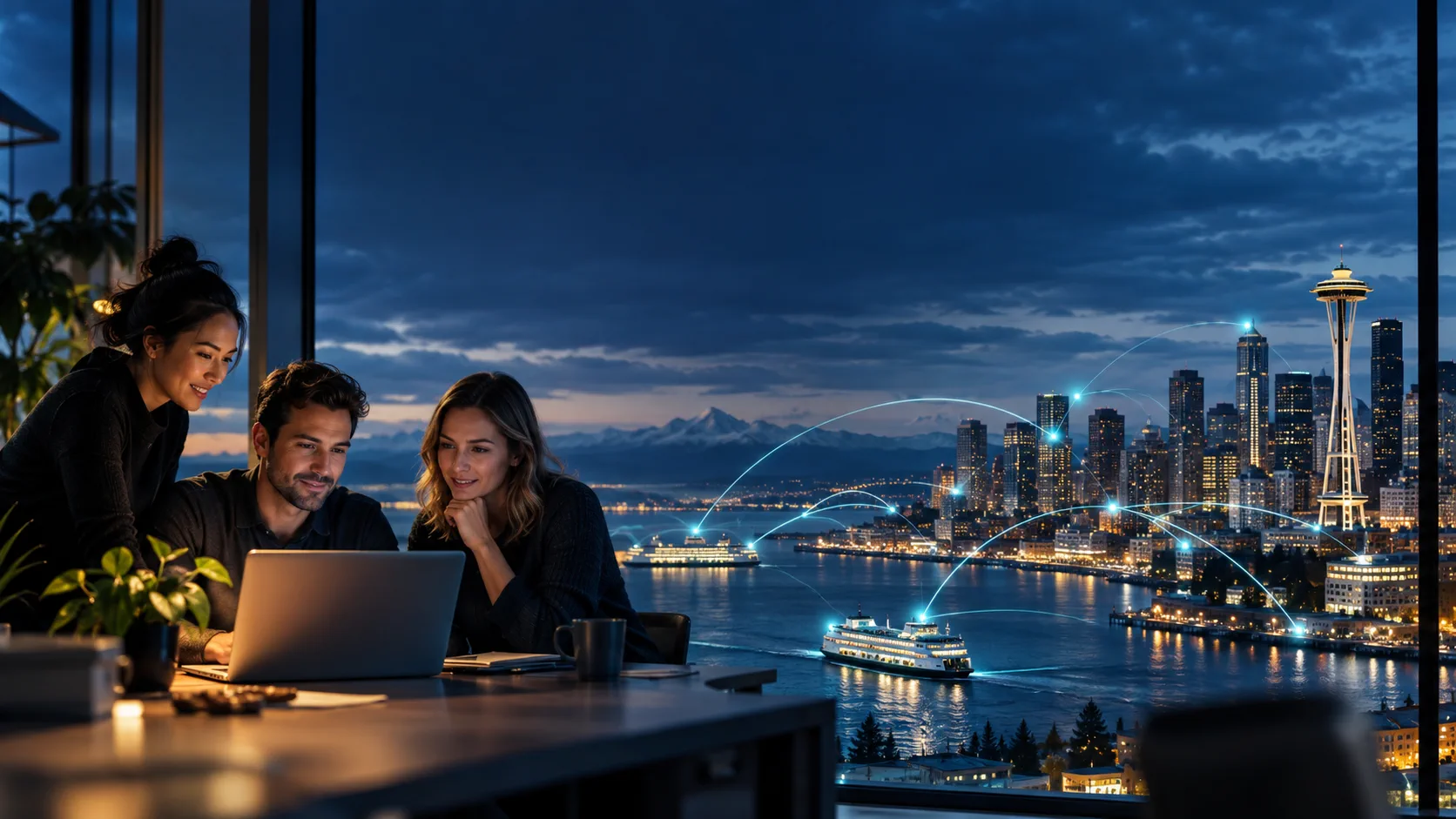
One city, four economies
Tech & Startups
RAG knowledge assistants for startups, agency lead routing, and owner dashboards — systems your engineers will respect because they're scoped, measured, and yours.
Healthcare
Clinic intake on First Hill: forms, eligibility, and scheduling prepared for staff approval. AI never makes clinical decisions; licensed clinicians review and sign.
Maritime & Port Trades
Maritime and freight paperwork — the forms, certificates, and status chasing between the waterfront, SoDo, and the office.
Professional Services & Trades
Missed-call recovery for the trades, professional-services automation for firms that sell expertise by the hour, and deep integrations with the software you already run.
How Seattle does business
Seattle is one of the densest technology markets in the world — Amazon's headquarters, major engineering offices for nearly every large tech company, and a startup scene concentrated in South Lake Union, Pioneer Square, and Fremont. That density sets a high bar: Seattle businesses expect AI work that would pass review at a tech company, not a chatbot bolted to a contact form.
But most of Seattle's economy isn't Big Tech. It's the region's healthcare systems (UW Medicine, Swedish, Virginia Mason Franciscan), the maritime and port economy moving cargo through the Port of Seattle, professional-services firms in the downtown core, and thousands of restaurants, clinics, contractors, and shops from Ballard to Columbia City. Those businesses feel the region's labor costs hardest — which is exactly where automation pays back fastest.
We build for both audiences: production-grade AI for teams with engineers who will read the code, and practical automation for owners who just need the phone answered, the leads followed up, and the paperwork to stop eating their evenings.
Seattle, district by district
Seattle is one of the densest technology markets in the world — Amazon's headquarters, major engineering offices for nearly every large tech company, and a startup scene concentrated in South Lake Union, Pioneer Square, and Fremont. That density sets a high bar: Seattle businesses expect AI work that would pass review at a tech company, not a chatbot bolted to a contact form.
But most of Seattle's economy isn't Big Tech. It's the region's healthcare systems (UW Medicine, Swedish, Virginia Mason Franciscan), the maritime and port economy moving cargo through the Port of Seattle, professional-services firms in the downtown core, and thousands of restaurants, clinics, contractors, and shops from Ballard to Columbia City. Those businesses feel the region's labor costs hardest — which is exactly where automation pays back fastest.
| Local friction | First automation | Outcome to measure |
|---|---|---|
| Answers are scattered across Notion, Slack, Drive, and product docs | A citation-grounded knowledge assistant connected to approved sources | Faster onboarding and fewer repeated interruptions for technical teams |
| Freight, customs, and maritime documents are re-keyed between systems | Document extraction, validation, and exception routing | Cleaner traceability and less dispatcher time spent on data entry |
| After-hours calls reach voicemail at neighborhood businesses | A disclosed AI phone agent with booking and human handoff | More captured demand without asking staff to stay on call |
Seattle AI automation questions
Do you meet Seattle clients in person?
Yes. We're based in Seattle, so discovery sessions, working meetings, and launches can happen at your office — Pioneer Square to Northgate. Most ongoing work runs remotely, but the option to sit down at the same table is a real difference from offshore or remote-only shops.
We're a tech company with our own engineers. Why hire you?
Because your engineers have a roadmap. We slot in for the AI-specific build — agent architecture, model integration, evaluation, automation plumbing — deliver documented code your team owns, and hand it off. No lock-in, no black boxes.
What do Seattle small businesses usually automate first?
Whatever leaks revenue: missed calls become an AI phone agent, slow quote follow-up becomes an automated sequence, and manual scheduling becomes self-serve booking. We start with the leak that has the clearest business case, then measure it before expanding.
What does custom AI development cost in Seattle?
Custom work is fixed-quoted after we map the workflow, systems, data, exceptions, approvals, and support requirements. You see the scope, exclusions, ownership, and third-party costs before paid implementation begins.
Can you deploy AI that keeps our data inside our own infrastructure?
Yes. For Seattle companies with sensitive data — healthcare, legal, maritime contracts — we deploy open-weight models and automation on your own servers or private cloud, so prompts and documents never leave your environment. It's the same local-AI infrastructure work we describe on our hardware page.
Do you work with Seattle nonprofits and public-sector adjacent organizations?
We do — donor and volunteer follow-up automation, grant-report drafting with human review, and multilingual constituent phone coverage are all builds we've scoped for mission-driven organizations, priced accordingly.
Request a Seattle review
Tell us what is getting in the way in Seattle. We'll reply with the most useful next step and a fixed scope.