Turn Costly Bottlenecks Into Custom AI Your Team Can Own
Turn your highest-cost bottlenecks into secure agents, automations, and integrations built around your operation—with clear ownership and no forced platform lock-in.
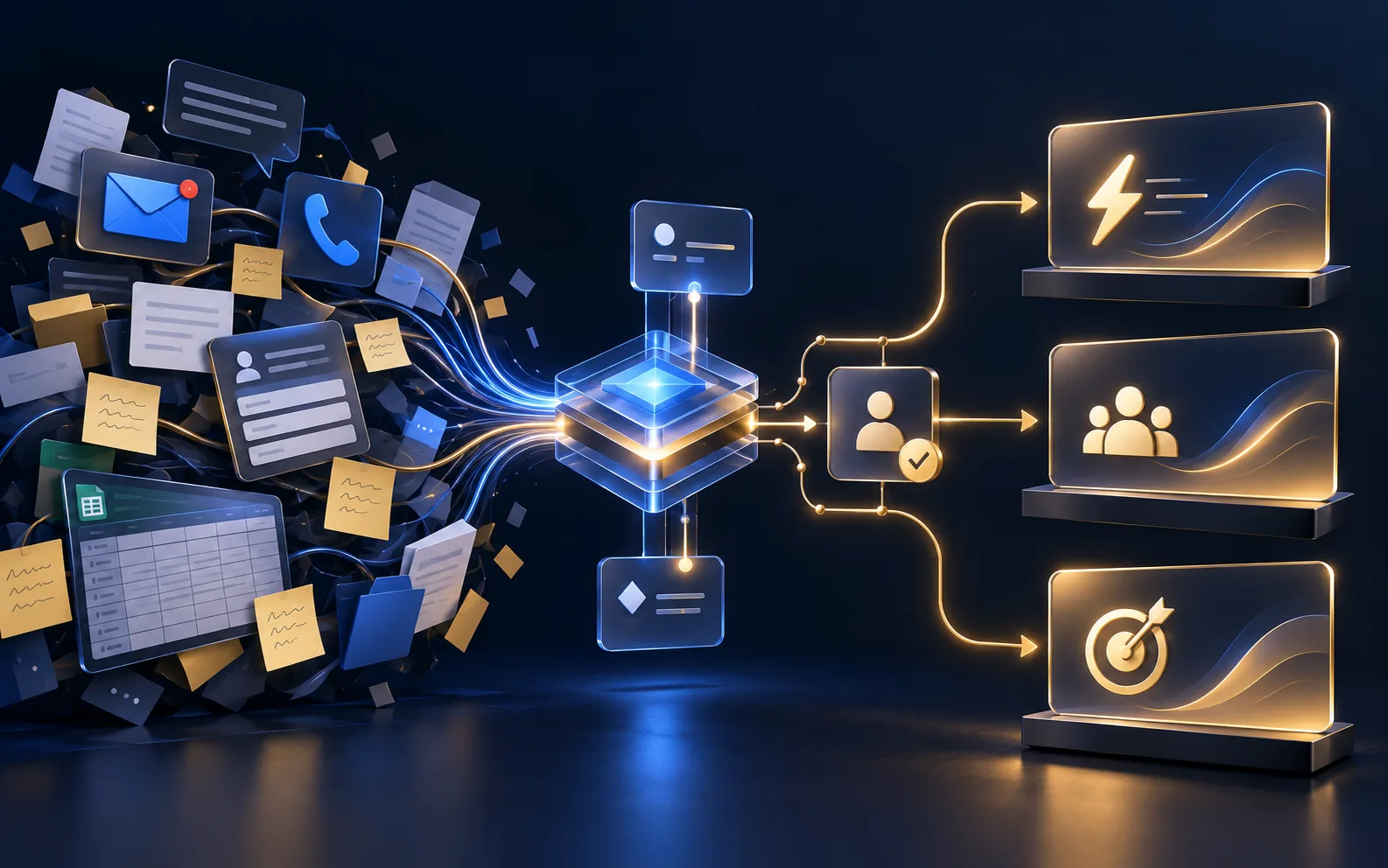
Generic AI breaks down when the work depends on your systems, rules, and private context.
A demo can look impressive while still failing the real operation. Useful custom AI has to fit the workflow, handle exceptions, protect access, and make human responsibility obvious.
Where the work gets stuck
- Knowledge is scattered
The information needed to act lives across tools, documents, messages, and experienced team members.
- Exceptions are the real workload
Simple automation stops when inputs vary, context is missing, or an approval decision matters.
- Nobody can explain the handoff
Teams lose confidence when an AI output appears without evidence, ownership, or a correction path.
Fit the system to the workflow—not the workflow to an AI demo.
- 01Define
Choose one use case, baseline, approval boundary, and result the team can observe.
- 02Connect
Give the system only the tools and context it needs, with least-privilege access.
- 03Evaluate
Test normal work, edge cases, failures, and handoffs before expanding the scope.
Reduce the cost of repetitive work and expensive rework, so your team can handle more customers and spend more time on work that produces revenue.
Client-owned assets · Human approval gates · Inspectable handoff · No outcome guarantees
Start with the constraint, not the tool
We define the workflow, owner, baseline, and review boundary before choosing what to automate or build.
AI Agents That Act
Autonomous agents that read, decide, and execute across your tools — not chatbots that just talk.
Useful Integrations
We connect the systems your workflow actually depends on, using available APIs, exports, and carefully scoped handoffs.
Production-Grade Builds
Real engineering: version control, testing, monitoring, and documentation. No brittle no-code duct tape.
Your Data, Your Rules
Private and local deployment options help keep access, retention, and model use aligned with your operating requirements.
LLM Integration
RAG pipelines, fine-tuning, function-calling, and multi-model routing tuned to your domain and budget.
You Own Everything
Every engagement ships source code, infra-as-code, and a runbook. No lock-in, no ransom.
Capabilities that compound
Custom AI Agents & Copilots
We design agents that handle real workflows end to end — triaging tickets, drafting proposals, reconciling data, booking appointments.
- Multi-step tool use & function calling
- Human-in-the-loop approvals
- Memory & context across sessions
- Guardrails and audit logging
Automation Pipelines
The repetitive work that eats your team's week — automated, monitored, and reliable.
- Document & data processing
- CRM & pipeline hygiene
- Report generation & distribution
- Event-driven triggers across apps
LLM & RAG Systems
Answer engines and assistants grounded in your own knowledge base — accurate, cited, and current.
- Retrieval-augmented generation
- Vector search over your docs
- Fine-tuned domain models
- Hallucination guardrails
Custom Software Around the AI
The dashboards, portals, and APIs that make the intelligence usable by your whole team.
- Web apps & internal tools
- APIs & webhooks
- Auth, roles, and billing
- Cloud or on-prem deployment
Questions, answered
How is this different from a no-code tool or a template?
How much does custom AI development cost?
How long until something is live?
Do you work with our existing tools?
How do you approach data and security?
What Clients Say After Using the System
These are the exact customer comments supplied to Custom AI Works.
“We upload images, audio, and text. The AI understands all of it together.”
“Multimodal AI lets our users search by photo and voice.”
“Their AI agents don't just chat—they take action across our tools.”
“We deployed an AI agent that books meetings, sends follow-ups, and updates CRM.”
“The RAG system they built answers questions from our internal docs with citations.”
“Our enterprise search finally works. It understands context, not just keywords.”
Individual client-reported experiences are not universal benchmarks or guarantees. Percentage and regulated-workflow statements are customer descriptions, not independent certifications; scope and requirements vary.
We needed automation that didn’t feel fragile. They built custom AI agents and private workflows that fit our business, plus AI phone agents that handle calls and capture leads after hours. It’s like adding a reliable team member who never sleeps.
What should be automated, and what should stay deterministic or human-led?
Show us the process, systems, exceptions, and approval points. We’ll help identify a practical first scope and the evidence needed to measure it.
- Which inputs, systems, and decisions repeat often enough to model?
- Where must a person approve, correct, or stop the workflow?
- How will the team test reliability before expanding the scope?